The Numbers: AI Adoption Rates in Hospitality
The data tells a clear story: AI hospitality adoption is accelerating, but unevenly. Approximately 60% of major hotel chains have deployed at least one AI tool by 2025, primarily for revenue management or guest messaging. Among independent hotels and small properties, adoption sits closer to 15-20% — though this figure is rising fast as affordable, easy-to-deploy solutions enter the market.
The adoption gap is largely a function of resources. Chain hotels have dedicated technology teams and vendor relationships. Independent properties often lack the time, budget, or technical expertise to evaluate and implement AI tools. But the economics are shifting. Guest messaging AI now costs as little as $40 per month per property, less than a single hour of front desk labor in most markets.
Investment trends point in one direction. Hospitality technology budgets allocated to AI have grown year over year, and properties that adopted AI tools in 2024-2025 report measurable ROI within the first 90 days. The gap between adopters and holdouts is becoming a competitive gap, visible in response times, review scores, and revenue performance.
5 AI Tools Hotels Are Actually Using in 2026
The AI hospitality market is maturing, and a handful of tools have established themselves as the go-to solutions across different categories. Here is what hotels are actually using, not what vendors are pitching.
| Tool | Category | Best For | Price Range | Key Feature |
| Alfred | Guest messaging | Small-mid properties | From $40/mo | AI-first, multichannel, 10-min setup |
| Duetto | Revenue management | Mid-large hotels | $500–$2,000/mo | Predictive pricing, PMS integration |
| IDeaS | Revenue management | Hotel chains | Custom pricing | Demand forecasting, rate optimization |
| ALICE / Actabl | Operations | Full-service hotels | $200–$800/mo | Housekeeping, maintenance, task mgmt |
| Revinate | Guest data / marketing | All hotel types | $300–$1,000/mo | Guest profiles, email automation |
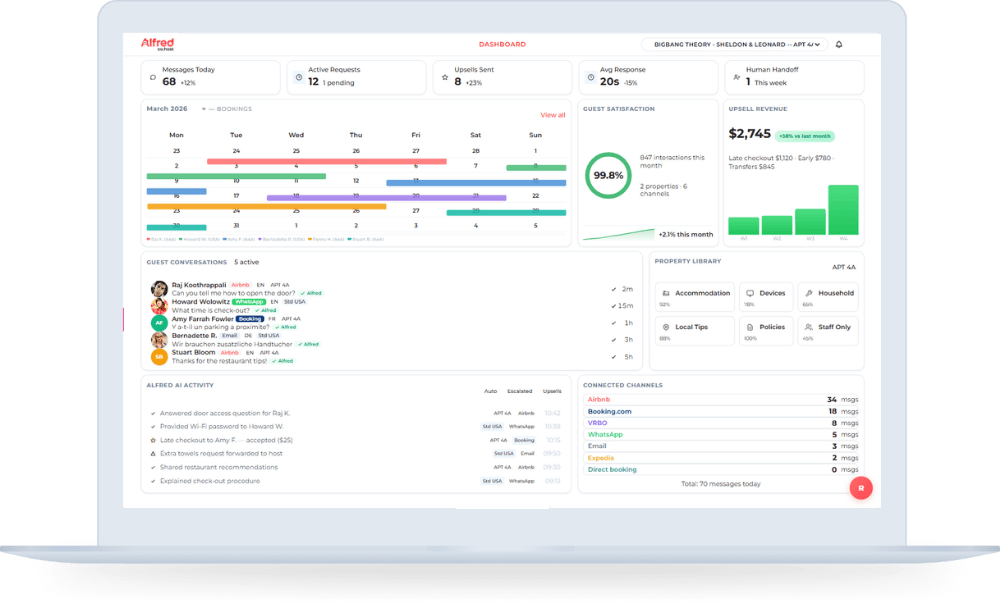
Alfred stands out in the hotel AI concierge and guest messaging space as the most accessible option for independent properties and small chains. As an AI guest assistant, it connects to WhatsApp, Airbnb, Booking.com, and email in under 10 minutes with no technical setup required. For properties looking to explore the broader landscape, see our roundup of the best digital concierge solutions.
Duetto and IDeaS dominate revenue management, though they serve different segments. Duetto is favored by mid-size and large hotels for its predictive pricing engine and deep PMS integration. IDeaS is the enterprise choice, powering rate optimization for major hotel chains with complex demand patterns.
ALICE (now part of Actabl) handles operational automation for full-service hotels: housekeeping scheduling, maintenance workflows, and cross-department task management. Revinate focuses on the guest data layer, building rich guest profiles and automating marketing communications based on stay history and preferences.
Will AI Replace Hotel Staff?
The short answer: no. AI augments hotel staff. It does not replace them. The longer answer requires nuance. Certain roles are being transformed significantly. Night desk positions, reservation call centers, and repetitive administrative tasks are the most impacted. These roles involve predictable, rule-based work that AI handles efficiently.
But the roles that define hospitality — the concierge who reads a guest's mood, the GM who navigates a crisis, the front desk agent who turns a complaint into loyalty. These require empathy, judgment, and creativity that AI cannot replicate. The most effective hotels in 2026 use AI to handle the 80% of tasks that are repetitive, freeing staff to focus on the 20% that create memorable guest experiences.
Industry data supports this: hotels that deploy AI report redeploying staff hours rather than cutting headcount. The AI at the front desk handles routine inquiries while human staff focus on complex requests, upselling, and relationship building. The result is better service, not fewer people.
What Is Holding Hotels Back from AI Adoption?
Despite clear benefits, barriers remain. Five factors consistently slow smart hotel technology adoption across the industry.
Integration complexity: Many hotels run legacy property management systems (PMS) that were not built for modern API integrations. Connecting AI tools to these systems requires custom development or middleware, adding cost and risk. The trend: newer AI tools are building pre-built PMS connectors and offering no-code setup.
Staff resistance: Fear of job displacement creates pushback. Effective adoption requires clear communication that AI handles tasks, not roles. Properties that involve staff in the implementation process report smoother transitions.
Cost uncertainty: Without clear ROI benchmarks, budget approval stalls. The fix: start with the lowest-cost, highest-impact category, guest messaging, and expand from proven results.
Data privacy concerns: Handling guest data through AI raises GDPR and privacy questions. Choosing tools with strong data governance and transparent policies is non-negotiable.
Lack of technical expertise: Smaller properties have no IT department. The market is responding with tools that require zero technical knowledge to deploy — setup in minutes, not months.
Want Alfred to Handle This for You?
Alfred automates guest communication across every channel. No technical setup, no integration headaches. Start in under 10 minutes.
What Comes Next: AI Hospitality Trends for 2027 and Beyond
The AI hospitality trajectory points toward deeper integration and broader accessibility. Four trends are shaping the next phase.
Predictive guest experience: AI will move from reactive (answering questions) to predictive (anticipating needs). Systems that know a returning guest prefers a quiet room on a high floor will pre-assign it before arrival.
Hyper-personalization: Every touchpoint, from booking confirmation to post-stay follow-up, will be tailored based on guest data. Generic communication will become the exception, not the norm.
AI-driven sustainability: Energy management, waste reduction, and resource optimization powered by AI will become standard as properties face rising energy costs and guest demand for sustainable practices.
Autonomous operations for small properties: This is the biggest shift. Tools like Alfred are making it possible for a single host to manage multiple properties with the service quality of a fully staffed hotel. An AI-powered receptionist combined with automated operations means independent hosts can compete with chains on guest experience. For more Airbnb hosting tips on leveraging these tools, see our host guides.
Final Thoughts
AI in the hotel industry is no longer a future trend. It is the present operating standard for competitive properties. The hotels winning in 2026 are the ones that started with guest communication automation, then expanded into pricing and operations. If you have not started yet, guest messaging is the highest-impact, lowest-barrier entry point. An AI-powered receptionist handles the task that consumes the most staff hours. Try Alfred free to see the difference in your first week.