Is Airbnb Arbitrage Still Profitable in 2026?
Yes, Airbnb arbitrage is still profitable in 2026 -- but only in the right markets and with the right operational setup. The days of listing any apartment and printing money are over. Hosts who profit today are those who analyze market data before signing a lease, keep startup costs lean, and automate their guest operations to reduce per-unit labor costs.
The numbers tell a nuanced story. According to AirDNA, the average US Airbnb occupancy rate in 2025 was approximately 56%, down from 62% in 2021. Average daily rates (ADR) have plateaued in most metro areas after years of post-pandemic growth. Meanwhile, rental costs have continued climbing -- the median US rent exceeded $1,900 per month in late 2025. This compression of the rent-to-revenue ratio is why market selection matters more than ever.
Properties using dynamic pricing averaged 27% higher occupancy than static-rate listings, according to AirDNA data. That gap represents the difference between profitability and break-even for many STR arbitrage operators. The hosts making strong returns in 2026 combine smart market selection with automation tools that keep operating costs low and guest satisfaction high.
Average Margins by Market Type
Not all markets produce the same returns. Here are the realistic margin ranges for arbitrage operators in 2026:
- Urban markets (major metros): 15-25% net margins. High ADR but high rents, more competition, and stricter regulations compress profits. Best suited for operators who can scale to 5+ units.
- Suburban markets: 20-35% net margins. Lower rents and growing demand from remote workers and families. Less regulatory friction in most areas.
- Resort and vacation markets: 25-45% net margins. Seasonal variation is the main risk, but peak-season rates can be 3-5x monthly rent. Requires strong off-season pricing strategy.
The Economics of Rental Arbitrage: Costs vs Revenue
In the rental arbitrage model -- where you lease a property and sublet it nightly -- understanding your cost structure is critical. A unit that looks profitable at 70% occupancy can bleed money at 45%. Before you sign a lease, you need to map every cost and stress-test your revenue projections against conservative occupancy estimates.
Startup Costs: What You Actually Need
Launching a single arbitrage unit requires $5,000-$15,000 in upfront capital. Here is where that money goes:
- Security deposit and first/last month rent: $2,000-$4,000
- Furnishing and decor: $3,000-$8,000 (the largest variable -- IKEA-functional vs design-forward)
- Professional photography: $200-$500 (non-negotiable for listing conversion)
- Smart locks and tech: $200-$400
- Cleaning supplies and initial setup: $200-$500
- Listing setup and platform fees: $100-$300
Most operators target a full payback on furnishing costs within 3-4 months of operation.
Monthly Operating Costs Breakdown
Beyond rent, expect $500-$1,500 in monthly recurring costs per unit:
- Cleaning: $100-$400/month (depending on turnover frequency)
- Utilities: $150-$300/month
- Insurance: $50-$150/month (short-term rental specific policy)
- Platform fees: 3-15% of revenue (Airbnb host-only fee is ~3%, split fee is ~14-16%)
- Software and automation tools: $50-$200/month (PMS, dynamic pricing, AI guest management)
- Maintenance and supplies: $50-$100/month
Automation tools are a cost -- but they replace far more expensive alternatives. A virtual assistant costs $800-$1,200 per month per operator, while AI-powered guest management tools like Alfred run at a fraction of that cost. See Alfred pricing to compare.
5 Markets Where Airbnb Arbitrage Works in 2026
These five US markets offer favorable conditions for Airbnb arbitrage in 2026 based on rent-to-ADR ratios, regulation friendliness, and tourism demand. All data points should be verified against current market conditions before making investment decisions.
- Nashville, TN: Strong tourism demand year-round (music, bachelor/bachelorette parties, conventions). Average rents around $1,600 with ADR of $150-$200. STR-friendly regulations outside the downtown core.
- Kissimmee / Greater Orlando, FL: Theme park proximity drives consistent demand. Rents in the $1,400-$1,800 range with ADR of $130-$180. Family-oriented market with longer average stays.
- San Antonio, TX: Lower rents ($1,200-$1,500) with solid ADR ($110-$150). Growing tourism sector, Riverwalk area, and relatively light STR regulation. High rent-to-revenue ratio.
- Gatlinburg / Pigeon Forge, TN: Resort market with exceptional peak-season returns. Cabin rentals command $200-$400/night in peak. Off-season requires aggressive pricing strategy but annual margins remain strong.
- Gulf Shores, AL: Emerging beach market with lower acquisition and lease costs than Florida alternatives. Growing visitor numbers and limited STR supply create favorable conditions for early entrants.
Is Airbnb Arbitrage Legal? Regulations You Must Know
Airbnb arbitrage is legal in most places, but it operates within a web of regulations that vary dramatically by city, county, and state. Failing to understand these regulations is the fastest way to lose money in STR arbitrage. Here are the three categories you must address before signing a lease.
Lease agreements and subletting permission. Your lease must explicitly permit short-term subletting. Many standard leases prohibit subletting entirely. Negotiate this upfront -- some landlords will agree if you offer a higher rent or security deposit. Get it in writing.
Local short-term rental ordinances. Cities regulate STRs through permits, zoning restrictions, occupancy limits, and tax requirements. Some cities (New York, San Francisco, Los Angeles) have severely restricted or effectively banned short-term rentals in most residential zones. Others (Nashville, Austin, most Florida cities) have permitting processes that are navigable.
Insurance requirements. Standard renter's insurance does not cover short-term rental activity. You need a commercial or STR-specific policy. Airbnb's AirCover provides some protection, but it is not a substitute for your own insurance.
Disclaimer: This is general information, not legal advice. Consult a local attorney and your municipality before starting an STR arbitrage business.
How to Reduce Risk with Automation and AI
Airbnb arbitrage operators face three categories of risk: vacancy, guest experience failures, and regulatory compliance. Automation addresses the first two directly and helps with the third. The operators scaling successfully in 2026 are not working harder -- they are automating the repetitive tasks that eat into margins and guest satisfaction.
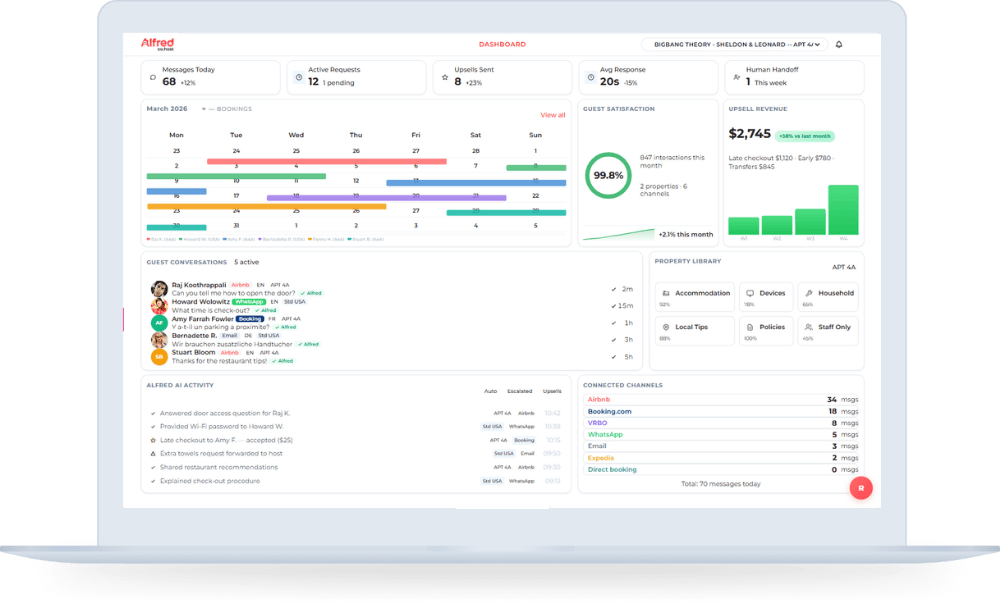
Automated guest messaging. Response time is one of the strongest predictors of booking conversion and review scores. An AI-powered receptionist responds to guest inquiries in under 2 minutes, 24/7, across every messaging channel. Manual response times average 15-60 minutes -- and every delay risks losing a booking.
Dynamic pricing. Tools like Pricelabs and Beyond Pricing adjust your nightly rates based on demand, seasonality, local events, and competitor pricing. Hosts using dynamic pricing see 15-25% higher revenue compared to static-rate listings. For Airbnb revenue management, automated pricing is no longer optional.
AI guest management. Beyond messaging, an AI concierge handles check-in instructions, local recommendations, issue resolution, and review requests. This reduces the host's per-unit time investment from 20-30 hours to 3-5 hours per month. See how automated guest messaging works.
| Dimension | Without Automation | With AI Automation | Impact |
| Guest response time | 15-60 minutes average | Under 2 minutes (24/7) | Higher review scores, fewer cancellations |
| Monthly time investment | 20-30 hours per unit | 3-5 hours per unit | Scalability: manage 5-10x more units |
| Pricing optimization | Manual rate checks weekly | Daily dynamic adjustments | 15-25% revenue increase |
| Guest satisfaction | Dependent on host availability | Consistent, instant, multilingual | Improved ratings, more repeat bookings |
| Operating cost per unit | $800-$1,200/mo (with VA) | $200-$400/mo (with AI tools) | 50-70% labor cost reduction |
Airbnb Arbitrage vs Owning: Which Model Is Right for You?
Arbitrage and property ownership are both viable paths to short-term rental income, but they suit different risk profiles and capital situations. Here is an honest comparison across the dimensions that matter most. If you are considering a hybrid approach, our co-hosting guide covers how to manage properties for other owners as a third option.
| Dimension | Arbitrage Model | Ownership Model |
| Upfront capital | $5,000-$15,000 | $50,000-$200,000+ (down payment) |
| Monthly risk | Lease obligation (fixed) | Mortgage + property taxes (fixed) |
| Exit flexibility | Walk away at lease end | Sell property (months/years) |
| Equity building | None | Yes -- appreciation + principal paydown |
| Scalability speed | Fast -- new lease in 2-4 weeks | Slow -- 30-90 days per acquisition |
| Profit margin range | 20-40% net (if managed well) | 10-30% net (higher equity offset) |
Neither model is inherently better. Arbitrage is ideal for operators who want to start fast with limited capital and test markets before committing to a short-term rental investment through ownership. Ownership builds long-term wealth but requires significantly more capital and carries property-specific risks.
Want Alfred to Handle Guest Communication for You?
Stop spending hours on guest messages across your arbitrage portfolio. Alfred automates 100% of guest communication with AI -- from booking inquiries to check-out reviews.
Getting Started: Your Airbnb Arbitrage Checklist
Ready to launch your first Airbnb arbitrage unit? Here is the step-by-step process from market research to first guest.
- Build your Airbnb business plan. Define your target market, budget, and financial projections before spending a dollar.
- Research markets with AirDNA or Mashvisor. Look for rent-to-ADR ratios of 2.5x or higher. Check local STR regulations.
- Find a landlord who permits subletting. This is the hardest step. Network with property managers, pitch the benefits (guaranteed rent, property care), and get subletting permission in the lease.
- Furnish smart, not expensive. Target $3,000-$5,000 for a 1-bedroom. Focus on durability, photography appeal, and guest comfort. Skip luxury items.
- Set up your tech stack. Property management system, dynamic pricing tool, smart locks, and AI guest messaging. Front desk automation saves you 20+ hours per month per unit.
- List on multiple platforms. Airbnb, Booking.com, and VRBO. Multi-channel distribution increases occupancy by 10-15%.
- Calculate your vacation rental ROI monthly and adjust. Track occupancy, ADR, expenses, and net margin. Use an Airbnb income calculator to benchmark against the market.
Final Thoughts
Airbnb arbitrage in 2026 is not dead -- but it demands sharper execution than it did three years ago. The hosts who profit are the ones who pick markets carefully, control costs, and automate relentlessly. If you are building or scaling an STR arbitrage business, start with a solid Airbnb business plan, calculate your margins with real data, and invest in automation tools that protect your guest experience and your time. Try Alfred free to see how AI guest management fits your operation.