How Much Does It Cost to Start an Airbnb?
Starting an Airbnb typically costs between $3,000 and $15,000 for furnishing and setup, depending on property size and market. Key expenses include furniture ($2,000-$8,000), professional photography ($150-$500), smart locks ($200-$400), insurance ($500-$2,000/year), and initial cleaning supplies ($200-$500). Budget 3 months of mortgage or rent as a cash reserve.
Here is the full breakdown of Airbnb startup costs:
| Cost Category | Low Estimate | High Estimate | Notes |
| Furnishing & Decor | $2,000 | $8,000 | Depends on property size and style |
| Professional Photography | $150 | $500 | Essential for listing conversion |
| Smart Locks & Tech | $200 | $400 | Keyless entry recommended |
| Insurance (annual) | $500 | $2,000 | Short-term rental specific policy |
| Cleaning Supplies & Setup | $200 | $500 | Initial stock |
| Platform Fees & Licensing | $100 | $1,000 | Varies by city |
These costs do not include your property acquisition or lease. If you are considering the Airbnb arbitrage model (leasing to sublet), add first and last month's rent ($2,000-$4,000) to your startup budget. For property owners, your down payment and closing costs are separate from these operational startup expenses.
What Your Airbnb Business Plan Should Include
A complete Airbnb business plan covers six core sections. Each section should be detailed enough to guide decisions and flexible enough to update as your market evolves.
- Executive Summary: Your property concept, target market, competitive advantage, and financial goals in one page.
- Market Analysis: Local STR market data -- average occupancy rates, ADR, seasonality patterns, competitor listings, and regulatory landscape.
- Financial Projections: Startup costs, monthly operating expenses, revenue model with occupancy targets, and break-even timeline.
- Revenue Model: Pricing strategy (static vs dynamic), channel mix (Airbnb, Booking.com, direct bookings), and seasonal rate adjustments.
- Operational Plan: Cleaning schedule, guest communication workflow, check-in/check-out procedures, maintenance protocols, and technology stack.
- Marketing Strategy: Listing optimization, photography standards, review management, social media presence, and repeat guest programs.
Executive Summary and Market Analysis
Start your business plan by defining what makes your property competitive. Research your local market using tools like AirDNA or Mashvisor to understand average nightly rates, occupancy patterns, and the number of active listings in your area. Identify your niche -- are you competing on price, location, amenities, or experience? Your executive summary should answer one question clearly: why will guests choose your listing over the 50 others nearby?
Financial Projections and Revenue Model
Your financial projections need to be conservative. Estimate revenue using 50-60% occupancy for your first year, not the 75-80% you hope for. Use a property investment calculator or comparable listing data to project realistic ADR. Factor in seasonality -- most markets have 2-3 slow months where occupancy drops 20-30%. Build a month-by-month cash flow projection and identify your break-even point. If you need help with the numbers, use our vacation rental ROI calculator to stress-test your assumptions.
How Do You Write an Airbnb Business Plan?
Write an Airbnb business plan in six steps: (1) research your local short-term rental market using AirDNA or Mashvisor, (2) define your property type and target guest, (3) calculate startup and monthly costs, (4) project revenue using comparable listings, (5) plan operations including cleaning, messaging, and pricing, (6) compile into a structured document.
The most common mistake is treating the business plan as a one-time document. Your plan should be a living reference that you update quarterly. Markets shift, regulations change, and your operational costs will evolve as you learn. Build your plan in a format that is easy to update -- a Google Doc or spreadsheet works better than a static PDF.
Focus your time on the financial projections and operational plan sections. These are where most hosts under-prepare. Your market analysis can be completed in a day using AirDNA data. Your operations plan -- how you will handle 50 guest turnovers per month, respond to messages at 2 AM, and manage a dynamic pricing strategy -- is what determines whether your business survives year one.
Download Your Free Airbnb Business Plan Template
We have built a free Airbnb business plan template that covers every section described above. The template includes pre-built financial projection spreadsheets, market analysis frameworks, and operational checklists. It is designed to be completed in 2-3 hours and customized for any market or property type.
What the template includes:
- Executive summary framework with fill-in prompts
- Market analysis worksheet (compatible with AirDNA data exports)
- 12-month financial projection spreadsheet with formulas
- Operational checklist covering cleaning, guest communication, and maintenance
- Pricing strategy planner with seasonal adjustment templates
Template download coming soon -- enter your email to be notified when it is available.
Want Alfred to Handle Guest Communication for You?
Your business plan says "automate guest messaging." Alfred makes it happen -- AI-powered responses across every channel, 24/7, in every language your guests speak.
Is Starting an Airbnb Still Profitable in 2026?
Airbnb hosting remains profitable in 2026 for hosts who approach it strategically. According to AirDNA, the average US short-term rental generated $32,000 in annual revenue in 2024, though this varies significantly by market. Hosts using dynamic pricing and automation tools like an AI-powered receptionist typically outperform the average by 15-25%.
The key factors that determine profitability in 2026 are market selection, operational efficiency, and guest experience quality. Saturated urban markets like Austin and Nashville have seen margin compression, but secondary markets and vacation destinations continue to offer strong returns. The hosts who fail are almost always the ones who skipped the planning phase -- which is exactly why building a business plan matters.
If you are considering the rental arbitrage model (leasing properties to sublet), read our complete Airbnb arbitrage guide for a data-backed profitability analysis.
How Alfred Automates Your Airbnb Operations
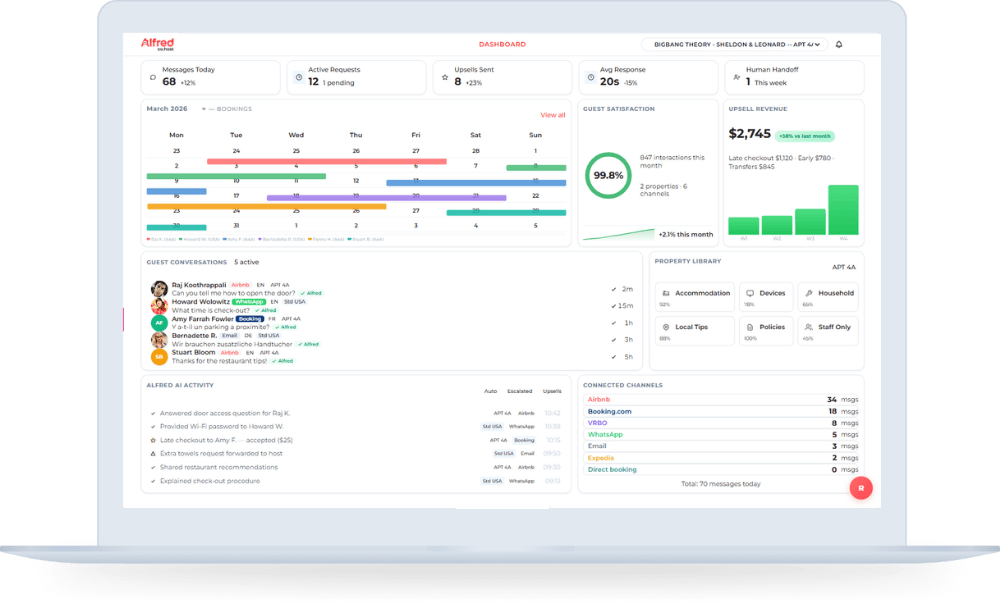
The operational plan section of your business plan will inevitably include guest communication -- and this is where most hosts either burn out or burn money hiring virtual assistants. Alfred is an AI concierge that handles 100% of guest messaging across Airbnb, Booking.com, WhatsApp, and email. It responds in under 2 minutes, 24/7, in over 30 languages.
For hosts building their first Airbnb business plan, Alfred fits into the "operations" and "technology stack" sections. For scaling hosts, it replaces the $800-$1,200/month virtual assistant line item with a fraction of the cost. Automate your guest messages from day one and build your business plan around systems, not manual labor. See Alfred pricing to factor it into your financial projections.
Next Steps: From Plan to Profitable Airbnb
A well-structured business plan for your Airbnb sets the foundation for sustainable revenue. Start with market research, build realistic financial projections, and plan your operations from day one. Download the free template above to get started. When your plan calls for automating guest communication -- and it should -- see how Alfred's AI receptionist handles 100% of guest messages across every channel, 24/7. Try Alfred free and turn your business plan into a running operation.