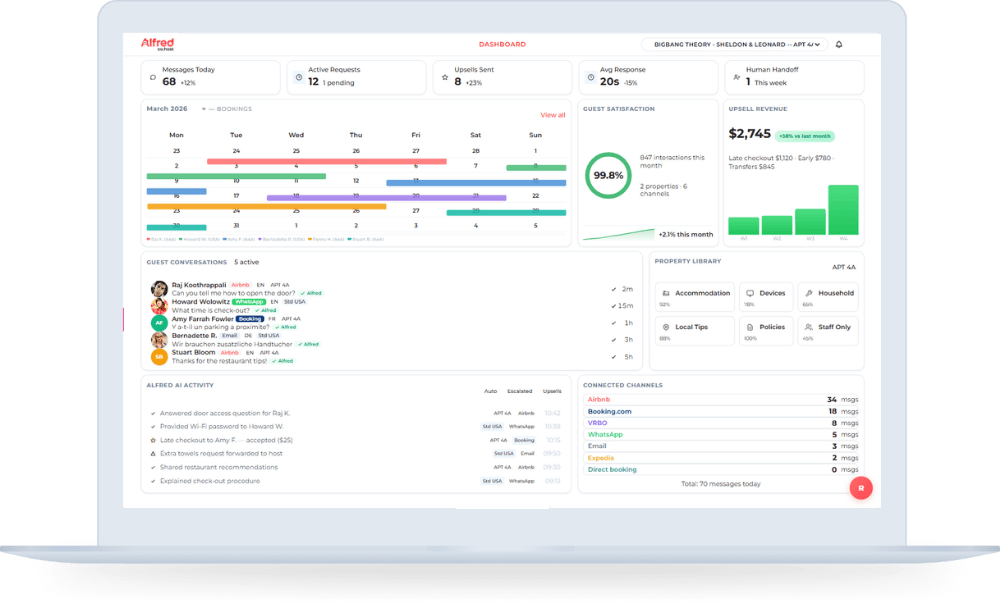
How Does an AI Guest Assistant Work?
An AI guest assistant combines natural language processing, a hospitality-specific knowledge base, and multi-channel integration to deliver instant, accurate responses. Here is how the core components work together to handle guest communication automatically.
Understanding Guest Intent
When a guest sends a message like "What time is checkout?" or "Can you recommend a good seafood restaurant nearby?", the AI parses the text using natural language processing to identify what the guest actually wants. It classifies the intent (checkout information, dining recommendation), extracts key details (time-related, cuisine preference), and matches the query against your property's knowledge base. This is fundamentally different from keyword matching: the AI understands that "When do I need to leave?" and "What time is checkout?" are the same question.
Multi-Channel Communication
Guests message from WhatsApp, Airbnb, Booking.com, email, SMS, and website chat, often switching channels mid-stay. An AI guest assistant connects to every channel through a unified dashboard, maintaining conversation context regardless of platform. A guest who asks about parking on WhatsApp and follows up about breakfast via Airbnb gets a coherent, connected experience. This is the core function of modern automated messaging in hospitality.
Learning from Your Property Data
The AI draws its answers from a knowledge base you configure: property descriptions, house rules, check-in/checkout procedures, WiFi credentials, local restaurant and activity guides, transportation options, and frequently asked questions. Setup typically takes 10 minutes. You provide the information once, and the AI uses it to generate natural, accurate responses. As you update your property details, the AI's responses update automatically. This functions as intelligent guest messaging software that improves with your input.
How Is an AI Guest Assistant Different from a Chatbot?
This is the most important distinction in hospitality technology today. A traditional chatbot follows pre-programmed scripts and decision trees. It works well for a narrow set of anticipated questions like "What is the WiFi password?" but breaks down when guests ask anything outside its script. The result is frustrating dead-ends, "I don't understand" responses, and guests who escalate to the host anyway.
An AI guest assistant uses natural language processing to understand context, handle questions it has never encountered before, and maintain multi-turn conversations naturally. When a guest asks "Is there somewhere nearby I can do laundry? We had a wine spill and we're here for three more days," the AI does not search for a keyword match. It understands the guest needs laundry facilities urgently, provides the nearest options (in-unit washer if available, laundromat with address and hours), and may proactively offer stain-treatment tips from its knowledge base.
| Capability | Traditional Chatbot | AI Guest Assistant | Manual Hosting |
| Response time | Instant (scripted) | Instant (contextual) | 2–12 hours |
| Novel questions | Cannot handle | Handles with NLP | Host responds |
| Languages | 1–3 pre-configured | 50+ auto-detected | Host language only |
| Channels | Usually 1 | All (WhatsApp, Airbnb, etc.) | Manual per platform |
| Setup time | Hours/days | 10 minutes | N/A |
| Guest satisfaction | Low (frustrating scripts) | High (natural conversation) | Varies (depends on host) |
What Are the Benefits of an AI Guest Assistant?
The benefits of an AI guest assistant extend across every dimension of hospitality operations, from guest satisfaction to host work-life balance. Here are the most impactful advantages for properties of every size.
24/7 Instant Response
Guests send messages at all hours, especially international travelers crossing time zones. An AI guest assistant responds instantly, whether the query arrives at 3 PM or 3 AM. No missed messages, no delays, no guests left wondering if anyone is managing the property. This eliminates the single biggest driver of negative reviews: slow or absent communication.
Multi-Language Support
An AI guest assistant auto-detects the guest's language and responds natively in 50+ languages. A Japanese guest asking about checkout in Japanese receives a fluent Japanese response without a translation app or awkward phrasing. For properties in tourist destinations serving international guests, this removes a major communication barrier without hiring multilingual staff.
Higher Guest Satisfaction and Reviews
Faster responses lead directly to better reviews, and better reviews lead to better platform ranking. Properties using AI guest assistants consistently report improvements in guest satisfaction scores. When every question gets an instant, accurate, friendly answer, guests feel well-cared-for, and they say so in reviews. For Airbnb hosts, this is a proven path to maintaining Superhost status.
Time Savings for Hosts
Hosts and property managers typically spend 10–15 hours per week on repetitive guest messaging: check-in instructions, WiFi passwords, local recommendations, checkout reminders. An AI guest assistant handles 80–90% of these messages automatically. That is 10–15 hours returned to your week, time you can invest in property improvements, guest experience upgrades, portfolio growth, or simply not working at midnight.
AI Guest Assistant Use Cases
AI guest assistants serve the full spectrum of hospitality, from single-unit vacation rentals to multi-property hotel groups. Here is how different property types benefit.
For Hotels and Boutique Properties
Hotels use AI guest assistants to supplement front-desk staff, handling pre-arrival questions, room service requests, and local recommendations without tying up phone lines or the reception desk. Boutique properties in particular benefit: they deliver the personalized communication guests expect from a small hotel without needing 24/7 front-desk coverage. An AI guest assistant functions as a dedicated hotel chatbot with real intelligence behind it.
For Vacation Rentals and Short-Term Rentals
Vacation rental hosts often manage properties remotely, making instant guest communication challenging. An AI guest assistant handles everything from pre-booking inquiries to post-checkout follow-ups. It sends check-in instructions at the right time, answers "Where are the extra towels?" at midnight, and provides personalized local recommendations based on your area guide. For STR operators, this is the difference between being a responsive host and a stressed one. Many hosts also pair it with a vacation rental chatbot strategy for maximum coverage.
For Property Managers with Portfolios
Property managers overseeing 10, 50, or 200+ units face a communication volume that manual processes cannot sustain. An AI guest assistant scales effortlessly across an entire portfolio, maintaining property-specific knowledge for each unit. Guests at Property A get answers based on Property A's details, never confused with Property B. Centralized dashboards show every conversation across every property and channel in one view.
AI Guest Assistant vs Virtual Concierge
The terms "AI guest assistant" and "virtual concierge" are related but serve different primary functions. An AI guest assistant focuses on handling all guest communication (questions, requests, check-in instructions, issue resolution) across every channel. A virtual concierge focuses specifically on local recommendations, experience booking, and upselling (restaurant reservations, tour bookings, late checkout for a fee).
In practice, the best AI guest assistants include virtual concierge capabilities as part of their feature set. Alfred, for example, handles both: it manages the full communication lifecycle while also providing local recommendations and enabling revenue-generating upsells. When evaluating options, look for a solution that combines both roles rather than requiring separate tools for communication and concierge services.
How to Choose an AI Guest Assistant
Not every AI guest assistant is built for hospitality. When evaluating options, focus on these criteria: Channel support: does it connect to WhatsApp, Airbnb, Booking.com, email, and SMS, or just a website widget? Language count: how many languages does it support, and is detection automatic? PMS integration: does it sync with your property management system for reservation data? Setup complexity: can you be live in minutes, or does it require days of configuration? Pricing transparency: is messaging unlimited, or do costs scale with volume? Human handoff: when the AI encounters something it cannot handle, does it escalate seamlessly to a human?
The best AI guest assistants are purpose-built for hospitality, not generic customer-service bots adapted for hotels. Look for solutions designed by teams that understand property management, guest expectations, and the specific communication patterns of short-term rentals and hotels.
How Alfred Works as Your AI Guest Assistant
Alfred is the premier AI guest assistant built exclusively for hospitality. Setup takes 10 minutes: connect your messaging channels, add your property details, and Alfred begins handling guest communication immediately. It responds to messages across WhatsApp, Airbnb, Booking.com, email, and SMS in 50+ languages, 24/7.
Alfred learns from your property's knowledge base: house rules, check-in procedures, local recommendations, and FAQ. It handles routine communication automatically while escalating complex requests to your team with full conversation context. For property managers, a centralized dashboard provides visibility across every property and channel. Alfred is designed to make every host look like a world-class AI receptionist: responsive, knowledgeable, and always available.
Want Alfred to Handle This for You?
Stop spending hours on repetitive guest messages. Alfred handles check-ins, recommendations, and guest questions across every channel so you can focus on hospitality, not your inbox.
Get Started with an AI Guest Assistant
An AI guest assistant is the most impactful technology shift in hospitality communication since online booking platforms. It solves the fundamental problem every host faces: guests expect instant, personalized responses across every channel, in every language, at any hour. The technology is mature, setup takes minutes, and the ROI is measurable within the first month. Whether you manage a single vacation rental or a boutique hotel, explore what an AI receptionist can do for your property, or try Alfred free and experience it firsthand.