How Does an AI Receptionist Work?
Understanding how an AI receptionist works removes the mystery and helps you evaluate whether a solution is genuinely AI-powered or just a dressed-up FAQ bot. The technology relies on three core components: natural language understanding, multi-channel integration, and a property-specific knowledge base connected to your operations.
Natural Language Understanding
Natural language processing (NLP) is what allows an AI receptionist to understand guest messages regardless of how they are phrased. A guest might ask "What time is check-in?", "When can I arrive?", or "Can I get into the apartment early?" — all meaning the same thing. The AI parses intent, not keywords. It classifies the message, matches it against the property knowledge base, and generates a contextual response. Advanced systems maintain conversation context across multiple messages, so a guest does not need to repeat themselves.
Multi-Channel Integration
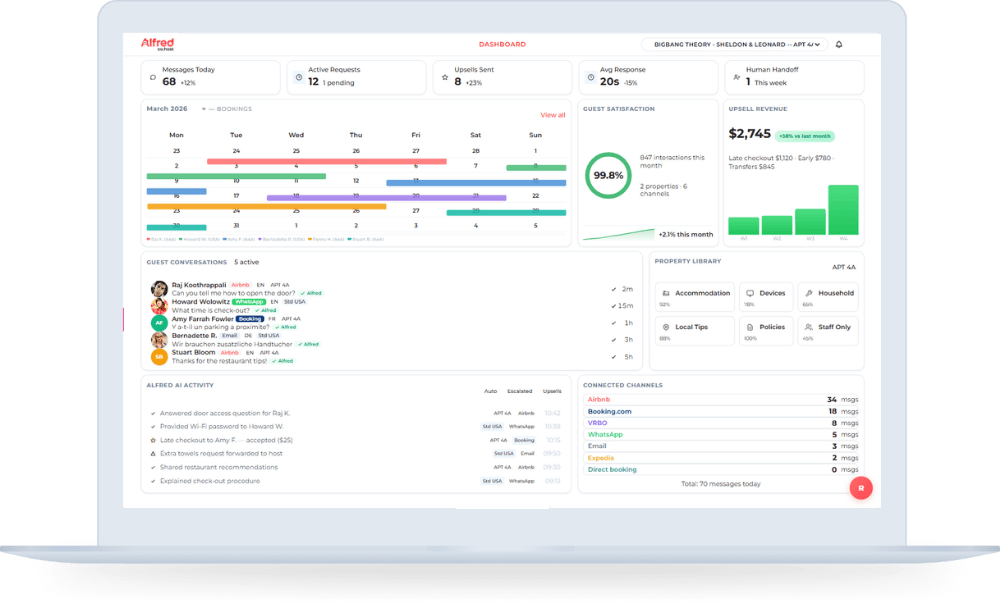
A hospitality AI receptionist connects to every channel where guests communicate: WhatsApp, Airbnb messaging, Booking.com messaging, email, SMS, and sometimes webchat. The key is that all conversations are managed from one system — the AI responds on the channel the guest used, in the language the guest wrote in, with property-specific information. This eliminates the need to monitor five different inboxes. For more on channel automation, see our guide to automated guest messaging.
Is an AI Receptionist the Same as a Chatbot?
This is one of the most common questions, and the answer matters for your buying decision. An AI receptionist is not the same as a traditional chatbot. The difference is fundamental.
A chatbot follows pre-written decision trees. It presents options ("Select 1 for check-in, 2 for directions, 3 for something else") and gives scripted responses. If a guest asks a question that is not in the tree, the chatbot fails, typically with a generic "I don't understand" or a redirect to human support. Chatbots work for simple, predictable interactions but break down in hospitality where guest questions are varied and context-dependent.
An AI receptionist uses natural language processing to understand context, answer questions it has never seen before, and maintain multi-turn conversations. It learns from your property data, not from a script. The difference is flexibility: a chatbot handles FAQs; an AI receptionist handles genuine guest communication, including edge cases, follow-up questions, and nuanced requests that no decision tree could anticipate.
AI Receptionist Use Cases in Hospitality
The AI receptionist applies across every hospitality property type, but the specific use cases vary by operation size and guest communication patterns.
Hotels and Boutique Properties
Hotels use AI receptionists to handle the high volume of pre-arrival and in-stay inquiries that overwhelm front desk staff. Common use cases include pre-arrival information (parking, check-in procedures, local transport), in-stay requests (extra towels, restaurant recommendations, room service inquiries), and post-stay follow-ups. For boutique properties, an AI-powered receptionist for hotels delivers the responsiveness of a large chain without the staffing cost.
Vacation Rentals and Short-Term Rentals
Vacation rental hosts face a unique challenge: guests expect hotel-level responsiveness from a property that may not have on-site staff. An AI receptionist handles the check-in instruction delivery, mid-stay questions ("How does the coffee machine work?"), and issue escalation that previously required the host to be available 24/7. For hosts managing multiple listings across Airbnb and Booking.com, the automation is transformative — one AI handles all properties, all channels, all languages.
BnBs and Hostels
Smaller properties like BnBs and hostels often have a single owner-operator handling everything. An AI receptionist takes the most time-consuming task off their plate: responding to the same questions dozens of times per week. Check-in times, WiFi passwords, local recommendations, house rules — all handled automatically while the host focuses on the in-person experience that makes small properties special. For more operational tips, see our hosting tips guide.
What to Look for in an AI Receptionist
Not all AI receptionist solutions are equal. When evaluating tools for your property, focus on six criteria that separate effective solutions from marketing hype.
Channel coverage: The tool must connect to every platform where your guests message you: Airbnb, Booking.com, WhatsApp, email, SMS at minimum. If it only works on one channel, it solves one-fifth of the problem.
Language support: For properties in tourist markets, automatic language detection and native responses are essential. The AI should respond in the guest's language without manual configuration.
PMS integration: Connection to your property management system means the AI can pull real-time booking data like guest names, arrival dates, and property assignments into its responses.
Setup time: If implementation takes weeks of training and configuration, the tool is not designed for hospitality operators. The best solutions go live in minutes, not months.
Pricing model: Look for transparent per-property pricing. Avoid tools that charge per message or per conversation, since these costs become unpredictable during peak season.
Human handoff: The AI must know its limits. When a guest issue requires human judgment (a complaint, a special request, an emergency), the system should escalate smoothly to a human operator with full conversation context.
The ROI of an AI Receptionist for Hosts
The return on investment for an AI receptionist is straightforward to calculate because the inputs are measurable: time spent on messages, response time, and guest satisfaction scores.
| Guest Communication Task | Without AI Receptionist | With AI Receptionist | Impact |
| Response time | 2–12 hours average | Under 30 seconds | Guest satisfaction +25% |
| After-hours coverage | No coverage | 24/7 instant | Zero missed inquiries |
| Multi-language | Manual translation | Auto-detected, native | Broader guest reach |
| FAQ handling | 3–5 hours/week manual | Fully automated | Time saved: 3–5 hours |
| Check-in instructions | Manual per booking | Auto-sent per booking | Zero forgotten check-ins |
Most properties report saving 3-5 hours per week on guest messaging alone. For hosts managing multiple properties, the savings multiply. Response times drop from hours to under 30 seconds, which directly impacts guest satisfaction scores and review ratings. Properties using AI receptionists consistently report improvements in their Airbnb Superhost metrics and Booking.com review scores, the two factors that most directly affect future bookings and revenue.
Want Alfred to Handle This for You?
Alfred responds to your guests across WhatsApp, Airbnb, Booking.com, and email, in any language, in under 30 seconds. Set it up in 10 minutes.
How Alfred Works as Your AI Receptionist
Alfred is built specifically for hospitality guest communication, not adapted from a generic chatbot platform. Here is how it works in practice.
Setup takes under 10 minutes. You connect your messaging channels (WhatsApp, Airbnb, Booking.com, email), add your property information (house rules, check-in instructions, local recommendations), and Alfred starts responding to guest messages immediately. There is no training period, no decision trees to build, no technical configuration required.
Alfred uses your property's specific knowledge base to generate contextual responses. When a guest asks "Where is the nearest supermarket?", Alfred answers with the actual nearest supermarket, not a generic response. When a guest writes in French, Alfred responds in French. When a guest follows up three messages later with a related question, Alfred maintains the conversation context.
The AI front desk handles routine inquiries automatically while flagging complex issues (complaints, special requests, emergencies) for human attention with full conversation history. You stay in control; the AI handles the volume.
Get Started with an AI Receptionist
An AI receptionist is the most impactful automation tool available to hospitality hosts in 2026. It handles the task that consumes the most time, guest communication, across every channel, in every language, without interruption. If you manage one property or fifty, the ROI calculation is straightforward: fewer hours spent on messages, faster response times, and better guest reviews.
Ready to see it in action? Explore the full AI receptionist capabilities or try Alfred free.