How to Screen Airbnb Guests Before Check-In
Effective guest screening follows a three-step process that takes minutes per booking but prevents the majority of problem stays. Each step adds a layer of verification. Skip one and you leave a gap that risky guests can exploit.
Check Guest Reviews and Profile Completeness
Start with the guest's platform profile. Look for verified identity badges, a complete bio, and a profile photo. Then read their reviews from previous hosts, not just the star rating but the actual text. Pay attention to mentions of communication, rule compliance, and property respect. A guest with 10+ stays and consistent positive reviews is a low-risk booking. An empty profile with no reviews is not automatically a red flag, but it means you need the next two steps to compensate.
Verify Identity Through the Platform
Airbnb's Verified ID feature requires guests to submit a government-issued ID that matches their profile information. Booking.com and VRBO have similar verification systems. Always require identity verification as a booking condition. This single step eliminates a large share of fraudulent or high-risk bookings. Guests who refuse ID verification are the clearest red flag in vacation rental screening.
Communicate Before Confirming
Send a brief pre-booking message asking about the purpose of their trip, who will be staying, and confirming they have read your house rules. Legitimate guests answer quickly and specifically. Watch for vague responses, reluctance to answer direct questions, or requests to move communication off-platform. This step also sets expectations. Guests who know you are attentive are less likely to push boundaries.
Red Flags in Guest Communication
Certain booking patterns and communication behaviors are consistently associated with higher-risk stays. Recognizing these red flags does not mean automatically declining. It means applying additional verification before confirming.
The highest-risk pattern is a last-minute local booking for a large property, especially for a single night on a weekend. This profile matches the majority of unauthorized party incidents. Other red flags include: no prior reviews combined with an empty profile, vague or evasive answers about trip purpose ("just a getaway" for a 10-person property), reluctance to provide identification, requests to communicate off-platform or pay outside the booking system, and booking a property far larger than the stated guest count would need.
None of these signals alone justifies declining a booking, but two or more in combination should trigger a direct conversation with the guest before you confirm.
Automated Guest Screening Tools
Manual screening works for hosts managing a few properties, but as your portfolio grows, automation becomes essential. Several tools now handle guest screening at scale using AI-powered risk scoring and background checks.
Autohost is the market leader in automated guest screening for vacation rentals. It integrates with most property management systems and runs background checks, ID verification, and risk scoring automatically when a booking request comes in. Superhog offers similar capabilities with a focus on damage protection guarantees. They underwrite the risk, so if a screened guest causes damage, Superhog covers the cost.
For communication-based screening, an AI guest assistant can analyze pre-arrival conversations for risk signals. These tools flag unusual patterns, like a guest avoiding direct questions or requesting rule exceptions, and alert you before check-in. The combination of automated ID verification and AI communication analysis covers the two main screening vectors without adding manual work to your workflow.
House Rules as a Screening Layer
Clear, specific house rules serve a dual purpose: they set expectations for good guests and deter problem bookings before they happen. Vague rules like "be respectful" are unenforceable. Instead, specify exact policies: no events or gatherings, quiet hours from 10 PM to 8 AM, maximum occupancy enforced by the booking platform, and no unregistered guests.
Require explicit confirmation of your house rules before check-in. This creates a documented agreement that strengthens your position if you need to file a damage claim or report a violation. Some hosts use a digital house rules generator to create professional documents that guests sign electronically. For more on financial protections, see our security deposits guide.
Want Alfred to Handle This for You?
Alfred automates pre-arrival guest screening by confirming house rules, verifying trip details, and flagging unusual communication patterns, so you catch risks before check-in.
How Alfred Supports Guest Screening
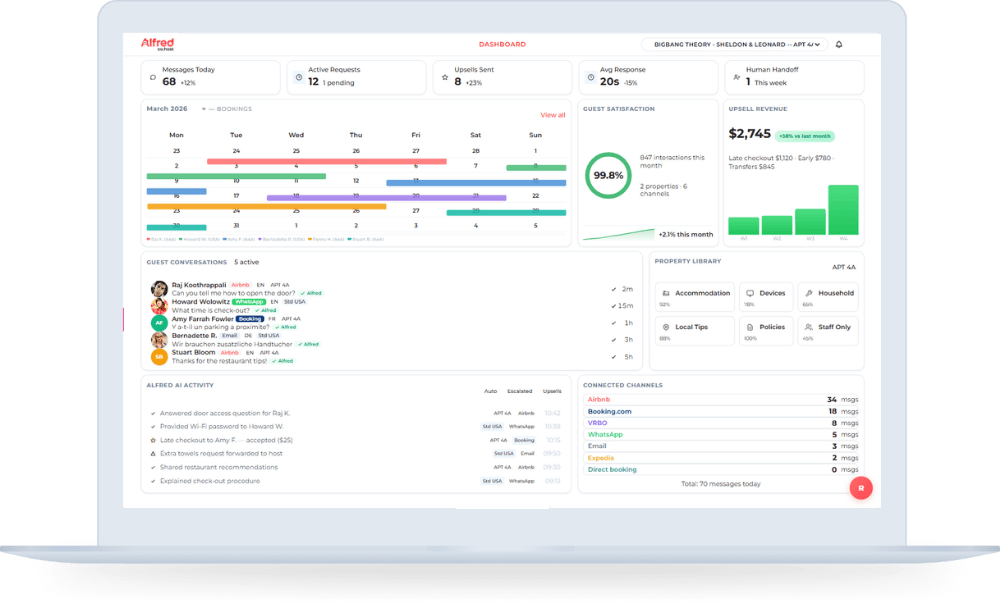
Alfred adds an intelligent communication layer to your screening process. When a guest books, Alfred can automatically send pre-arrival questions (trip purpose, guest count, estimated arrival time) and confirm house rule acknowledgment through natural conversation. Because Alfred handles automated messaging across WhatsApp, SMS, and platform chat, every guest interaction is logged and analyzed.
If a guest's responses include risk signals (evasive answers, requests for rule exceptions, or mismatched guest counts), Alfred flags the booking for your review before check-in. This gives you the information you need to make a decision without spending time on manual follow-ups.
Protect Your Property Starting Today
Guest screening for vacation rentals is a system, not a single step. Combine platform verification, pre-booking communication, clear house rules, and automated screening tools to protect your property without losing bookings. An AI-powered receptionist like Alfred adds another layer by managing guest communication, confirming house rules, and flagging unusual patterns before check-in. Try Alfred free and add intelligent guest communication to your screening workflow.